

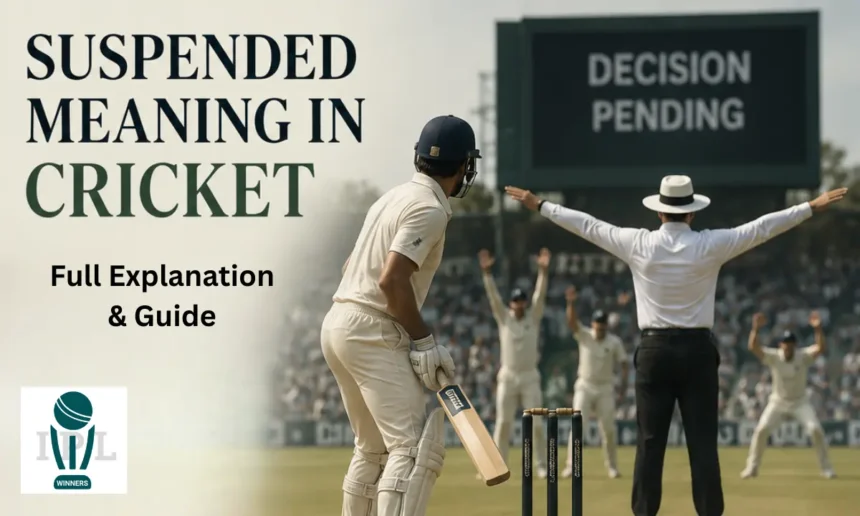
If you’ve ever been watching a live cricket match and suddenly seen the words “Match Suspended” flash across your screen, you’ve probably wondered exactly what that means for the game, the players, and the result. Is Suspended meaning in cricket the same as the match being cancelled? Does it mean someone got banned? Will the game resume later, or is it over for good?
The word “suspended” gets used in more than one way in cricket, and understanding each context helps you make sense of what’s actually happening — whether it’s rain interrupting a thrilling run chase or a player being pulled up for bad behavior. This article breaks down Suspended meaning in cricket, in plain, in easy-to-understand language.
Quick Overview: The Two Main Meanings
| Context | What It Means |
|---|---|
| Match Suspended | Play is temporarily halted due to conditions like rain, bad light, or safety concerns, with the intention of resuming later |
| Player Suspended | A player is barred from playing for a certain number of matches or period, usually due to disciplinary action or code of conduct violations |
Both uses of the word share the same core idea — a temporary stop — but they apply to very different situations. Let’s look at each one in detail.
What Does “Match Suspended” Mean in Cricket?
When commentators or scoreboards say a match has been suspended, it means the game has been temporarily stopped, but with the expectation that it will resume once conditions allow. This is different from a match being abandoned, which means the game is called off entirely with no possibility of continuing.
Common Reasons Matches Get Suspended
1. Rain
This is by far the most common reason. Cricket is played outdoors, and a wet outfield or a rain-soaked pitch makes it unsafe and impractical to continue. Once rain stops and ground staff clear the water using covers, super-soppers, and other drying equipment, play typically resumes.
2. Bad Light
In matches without sufficient floodlighting, or when floodlights aren’t considered strong enough for safe batting against fast bowling, umpires can suspend play due to poor visibility. This is especially common in Test cricket during overcast evenings.
3. Crowd Trouble or Safety Concerns
If spectators invade the pitch, if there’s crowd unrest, or if there’s a security threat, umpires and match officials can suspend play until the situation is brought under control.
4. Dangerous Playing Conditions
Sometimes the ground itself becomes hazardous — a slippery outfield, damaged pitch, or dangerous debris — leading umpires to halt play until conditions improve.
5. Technical or External Disruptions
On rare occasions, floodlight failures, power outages, or even smoke and air quality issues (as seen in some matches affected by pollution or wildfire smoke) have led to suspended play.
What Happens After a Match Is Suspended?
Once play is suspended, umpires continuously monitor conditions. If the issue clears up — say, rain stops and the ground becomes playable — play resumes from exactly where it left off. Depending on the format:
- In Test cricket, lost time can sometimes be added back using extra hours the next day.
- In ODIs and T20s, if too much time is lost, the match may be shortened using calculations like the Duckworth-Lewis-Stern (DLS) method, which recalculates target scores based on overs remaining and wickets lost.
- If conditions never improve enough to complete a minimum number of overs, the match can eventually be abandoned rather than merely suspended.
What Does “Suspended” Mean for a Cricket Player?
The second, and often more serious, meaning of “suspended” in cricket relates to player discipline. When a player is suspended, it means they are officially barred from participating in a certain number of matches or for a specified period, typically as a penalty for breaking rules.
Common Reasons Players Get Suspended
1. Code of Conduct Violations
Cricket’s governing bodies — the ICC (International Cricket Council) at the international level, and various boards domestically — enforce a Code of Conduct that governs player behavior. Breaches can include:
- Abusive language toward umpires or opponents
- Excessive appealing
- Dissent shown toward umpire decisions
- Physical altercations with other players
- Damaging the field or equipment out of frustration
Depending on the severity, violations are classified into levels (often Level 1 to Level 4), with harsher suspensions for more serious offenses.
2. Doping Violations
Like most professional sports, cricket has strict anti-doping regulations. A player who tests positive for banned substances can face lengthy suspensions, sometimes extending to years, depending on the substance and circumstances.
3. Corruption and Match-Fixing
This is among the most serious categories. Players found guilty of spot-fixing, match-fixing, or failing to report corrupt approaches can face suspensions ranging from several months to lifetime bans from the sport.
4. Ball-Tampering and Cheating
High-profile incidents of ball-tampering have led to significant suspensions in international cricket history, with players banned from certain formats or all cricket for a defined period.
5. Overs Rate Violations (Team-Level)
Sometimes it’s not an individual player but a team’s captain who is suspended due to the team’s slow over-rate in a match — a rule enforced to keep matches moving at a reasonable pace.
How Long Do Cricket Suspensions Last?
Suspension periods vary widely based on the offense:
| Violation Type | Typical Suspension Length |
|---|---|
| Minor Code of Conduct breach (Level 1) | Reprimand or fine, sometimes no suspension |
| Moderate breach (Level 2) | 1 Test or up to 2 ODIs/T20Is |
| Serious breach (Level 3) | Up to 4 Tests or several ODIs |
| Very serious breach (Level 4) | Extended bans, sometimes a year or more |
| Doping violations | Ranges from months to multiple years |
| Match-fixing/corruption | Can extend to a lifetime ban |
Suspended vs Banned: Is There a Difference?
People often use “suspended” and “banned” interchangeably, but there’s a subtle distinction:
- Suspended typically implies a temporary, defined period after which the player or restriction is lifted.
- Banned often carries a more permanent or indefinite connotation, though in casual cricket conversation, a long suspension is sometimes loosely called a “ban.”
For example, a player suspended for two matches due to a Code of Conduct breach will return automatically once that period ends. A player facing a lifetime ban for match-fixing, however, is permanently barred from any involvement in professional cricket.
Suspended vs Abandoned vs Rain-Delayed: Match Status Explained
Cricket fans often confuse these terms, so here’s a clear breakdown:
| Term | Meaning |
|---|---|
| Delayed | The start of play is pushed back, but the match hasn’t started yet |
| Suspended | Play has started but is temporarily paused, with intent to resume |
| Abandoned | The match is called off entirely with no play possible or remaining |
| Washed Out | Informal term often meaning the match was abandoned due to rain |
Understanding these distinctions helps fans know whether to expect the game to continue later that day, the next day, or not at all.
Real-World Examples of “Suspended” in Cricket
To make this more concrete, here are the kinds of situations where the term commonly appears:
- A T20I suspended due to rain, later resuming with a revised target calculated using the DLS method.
- A Test match session suspended for bad light, with players walking off and returning once floodlights or natural light improve.
- A bowler suspended for one match after breaching the ICC’s over-rate or conduct regulations.
- A domestic league match suspended due to crowd trouble, with officials waiting for security to restore order before resuming.
- An international player handed a multi-match suspension following a heated on-field clash with an opponent.
Why Understanding “Suspended” Matters for Fans
For casual viewers, knowing what “suspended” means helps set the right expectations. If you see a match suspended due to rain, you know there’s still a chance for the game to resume, especially in limited-overs cricket where reserve days or extended playing hours might apply. If you hear a player has been suspended, it tells you they’ll be unavailable for a specific number of upcoming matches — important information for fantasy cricket players, team selectors, and fans planning to watch their favorite players in action.
It also matters for the sport’s integrity. Suspensions tied to disciplinary or corruption issues reflect cricket’s efforts to maintain fair play, protect the game’s reputation, and hold players accountable for their conduct both on and off the field.
Frequently Asked Questions About Suspended meaning in cricket
It means play has been temporarily halted — usually due to rain, bad light, or safety concerns — with the intention of resuming once conditions improve.
No. A suspended match can still resume, while an abandoned match is called off completely with no further play possible.
If conditions never improve enough to complete the minimum required overs, the suspended match is eventually declared abandoned, and results are decided based on the format’s specific rules.
It means the player is officially barred from playing in a certain number of matches or for a specific time period, usually as punishment for violating the Code of Conduct, doping rules, or anti-corruption regulations.
This depends on the severity of the offense — ranging from a single match for minor breaches to a lifetime ban for serious corruption or match-fixing violations.
Match referees, the ICC’s Code of Conduct Commission, or relevant cricket boards and disciplinary panels determine suspensions based on the nature of the violation.
In most cases, yes — suspensions typically prevent match participation but don’t always restrict training or team involvement, depending on the specific terms of the suspension.
“Suspended” usually implies a temporary, defined period of exclusion, while “banned” often suggests a longer-term or permanent exclusion, though the terms are sometimes used interchangeably in casual conversation.
DLS is typically applied in limited-overs cricket (ODIs and T20s) when a suspension causes overs to be lost. It isn’t used in Test cricket, where lost time is instead managed through extended playing hours where possible.
While suspensions are usually applied to individual players, teams can face separate penalties like fines or point deductions for offenses such as slow over-rates, though “suspension” in the traditional sense usually applies to individuals rather than entire teams.
Final Thoughts
The word “suspended” in cricket carries two distinct but equally important meanings — one tied to the unpredictable nature of outdoor sport, where rain and light can pause play at any moment, and the other tied to the sport’s commitment to discipline and fair play, where rule-breakers face consequences that keep them off the field for a defined period.
Whether you’re watching a match get suspended due to a sudden downpour or hearing that a player has been suspended following an on-field incident, understanding these terms gives you a clearer picture of what’s really happening — and what to expect next, both for the game in progress and for the players involved.
Also, Read: Aiden Markram Wife | Ritika Sharma | Kavya Maran Age | Ziva Dhoni Age | Ananya Birla Boyfriend | Shubman Gill GF | Lockie Ferguson Wife | Kamil Mishara | Mohammad Basit Ali | Kuldeep Yadav Wife | Jatin Sapru Salary | Dion Myers | Madhav Tiwari | Danish Malewar | Rishita Patel | Sasha Hurly